 Stakely
How High Should Interest Rates Go? History Offers Clues, Not Answers
Monetary Policy·October 16, 2026
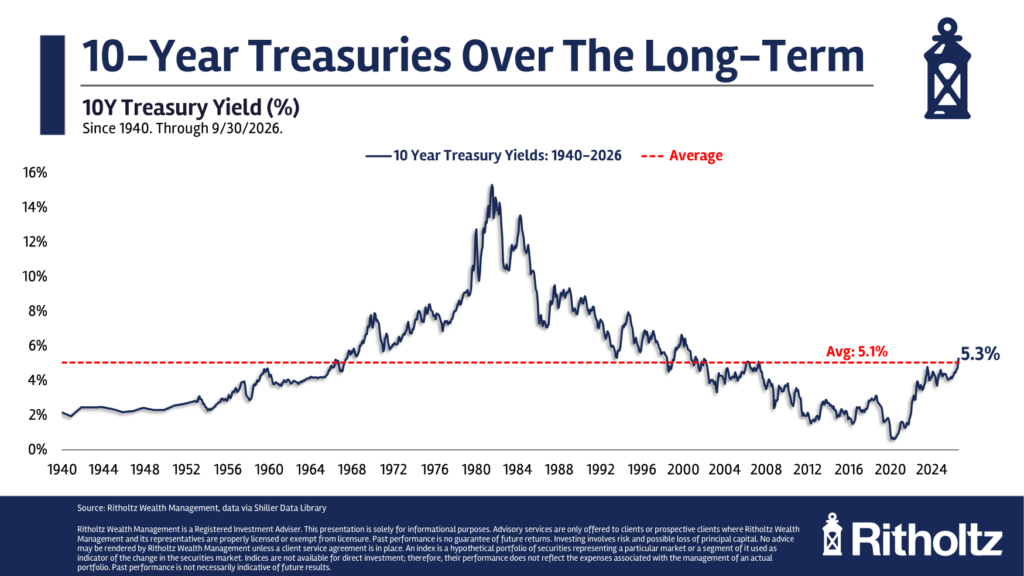
Ask an economist what the right level for interest rates is, and you are likely to get a qualified answer. Rates are the price of borrowing money, and that price shapes almost everything, from mortgage payments and business investment to the valuation of stocks. Set them too high and growth stalls. Set them too low and inflation can take hold. The hard part is that the right level is never fixed. It moves with productivity, demographics, public debt, and how households and businesses feel about the future.
History makes the point well. In the late 1970s, U.S. inflation climbed into double digits. Federal Reserve Chair Paul Volcker responded by pushing the federal funds rate to roughly 20 percent in 1981, which helped trigger a deep recession. The medicine was painful, but it broke the inflation spiral and set the stage for decades of relative price stability. Rates then drifted lower over the following years. After the 2008 financial crisis, the Fed held its target near zero from late 2008 until December 2015, and many observers came to see a low-rate world as the new normal.
That low-rate period was a response to crisis, though, not proof of a permanent new baseline. Economists use the term neutral rate, sometimes written as r-star, for the level that neither speeds up nor slows down the economy. The concept traces back to the Swedish economist Knut Wicksell in the late 1800s, but nobody can observe it directly. Analysts estimate it from data, and those estimates change over time. After the pandemic, the debate intensified. Inflation surged, and the Fed lifted its policy rate from near zero to a target range of 5.25 to 5.5 percent by mid-2023. Whether that level is restrictive or simply normal depends heavily on which estimate of the neutral rate you accept.
Rules of thumb try to bridge the gap. The Taylor rule, proposed by economist John Taylor in 1993, links the policy rate to inflation and to how far output sits from its potential. It is not a law, and central bankers treat it as one input among many. Its appeal is that it gives a consistent starting point, which matters when the cost of guessing wrong is high.
The clearest lesson from the record is humility. Rates that looked obviously too high in one decade looked obviously too low in another. Investors who assumed cheap borrowing would last forever were caught off guard when costs rose sharply. Savers who waited for rates to fall back again often waited a long time. For households and investors, the practical takeaway is to plan for a range of outcomes rather than a single forecast, to pay attention to how borrowing costs affect their own finances, and to remember that today's normal may not be tomorrow's.
Reporting based on an external source.