 Stakely
Social Security Won't Vanish, but Plan for a Smaller Check
Retirement·October 27, 2026
Every few years a poll or viral post reignites the same argument. Older Americans want their Social Security checks protected, and younger workers wonder whether those checks will exist when their own turn comes. The honest answer sits between the two extremes. The program faces a real funding gap, but running out of reserves does not mean running to zero.
The problem sits in one account. Social Security actually operates two trust funds. The disability fund is in comfortable shape and is projected to cover full benefits through the end of the 75-year forecast window. The retirement fund, known as OASI, is the one to watch. It has paid out more than it takes in since 2021, so it has been drawing down its reserves. According to the 2026 Trustees Report, those reserves are projected to be exhausted in 2032.
Money cannot move between the two funds without an act of Congress, so the analysis usually focuses on OASI alone. Once its reserves are gone, the system can pay only what incoming payroll taxes support. Under current projections, that means about 78% of scheduled benefits at the start, with the share sliding over time as the ratio of workers to retirees falls. By 2100 the projection drops to roughly 62%. These are forecasts rather than certainties, and lawmakers have a long record of acting before a shortfall becomes a cliff.
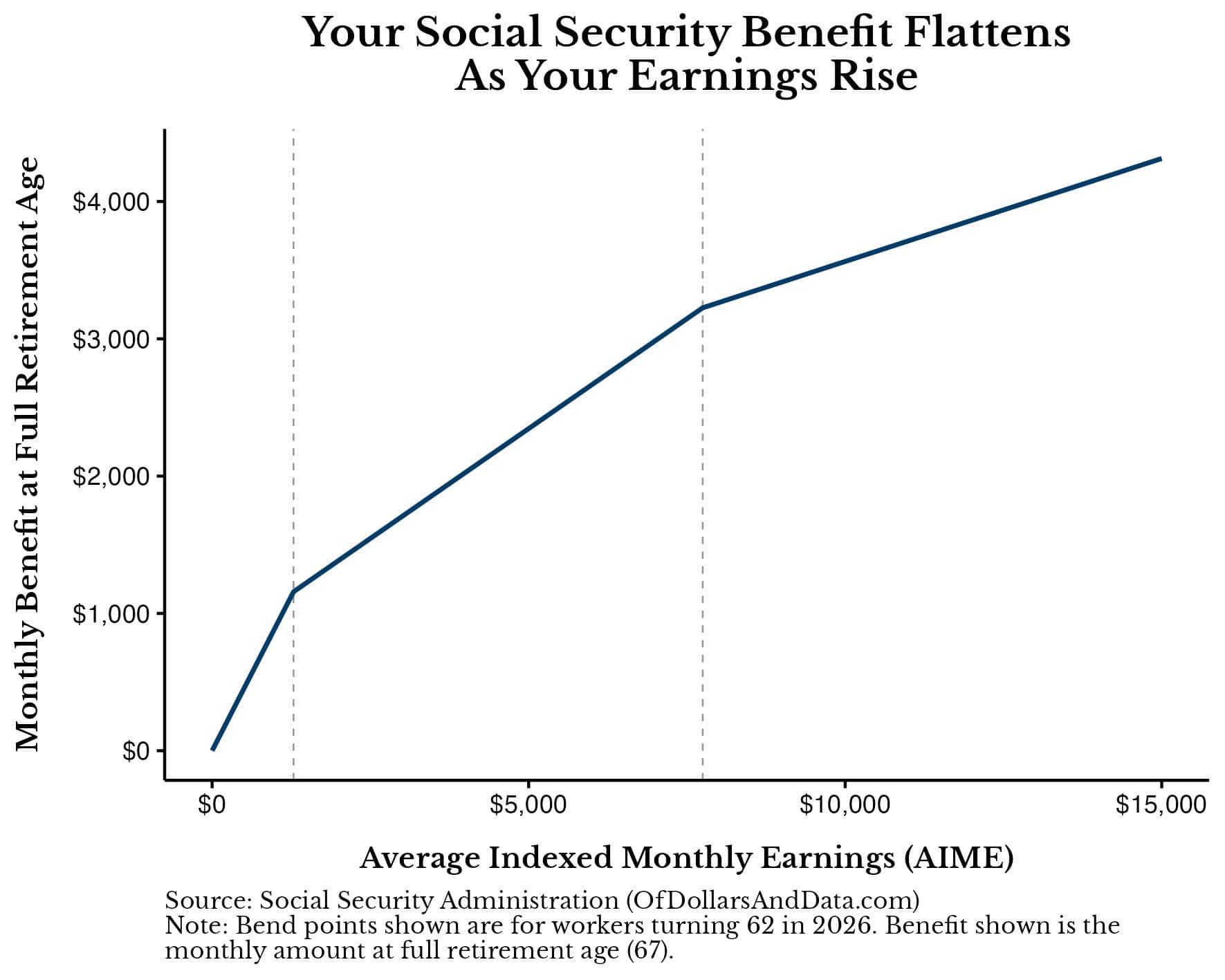
Understanding your own check means understanding how it is built. Benefits are not a simple reward for years worked. The Social Security Administration first adjusts each year of your earnings for growth in national average wages, so older paychecks are scaled up to reflect today's pay levels. It then takes your 35 highest adjusted years, adds them together, and divides by 420 months to produce an average indexed monthly earnings figure. That number runs through a formula with progressive brackets: 90% of the first slice, 32% of the next slice, and 15% of anything above that. Because the percentages shrink as income rises, lower earners replace a larger share of their pay than higher earners do.
Timing matters as well. Claiming at 62 permanently reduces the monthly amount, claiming at full retirement age produces the base figure, and waiting until 70 increases it. The gap between early and delayed claiming can be substantial, which makes the claiming age one of the few levers you fully control.
For fixing the program, the options are familiar. Lawmakers can raise revenue by increasing the payroll tax rate, removing the cap on taxable earnings, or taxing only income above a high threshold. They can also trim benefits by raising the retirement age, changing how the benefit formula is indexed, or reducing cost-of-living increases. Most single options close only part of the shortfall. A 2025 survey by the National Academy of Social Insurance found that 85% of respondents wanted benefits maintained or increased, even if that meant higher taxes. That points toward a tax-heavy compromise being more politically plausible than deep cuts, though it is a read on public opinion, not a law.
So can you count on Social Security? For planning, a sensible approach is to assume you will receive about 70% of the estimate shown in your my Social Security account, rather than the full figure or nothing at all. Someone who sees a projected $3,000 a month would plan around $2,100. Subtract that from the monthly spending you expect in retirement, multiply the gap by twelve, and apply a withdrawal rate such as the 4% rule to estimate how much you need saved on top of the benefit.
Nothing is guaranteed. Congress could change the rules in either direction, and projections will shift with each new Trustees Report. But the current math does not describe a program that pays nothing. Planning around a reduced check is prudent. Planning as though the check will not arrive is the bigger mistake.
Reporting based on an external source.