 Stakely
Why Corporate Earnings Are Outrunning the Stock Market
Markets·October 31, 2026
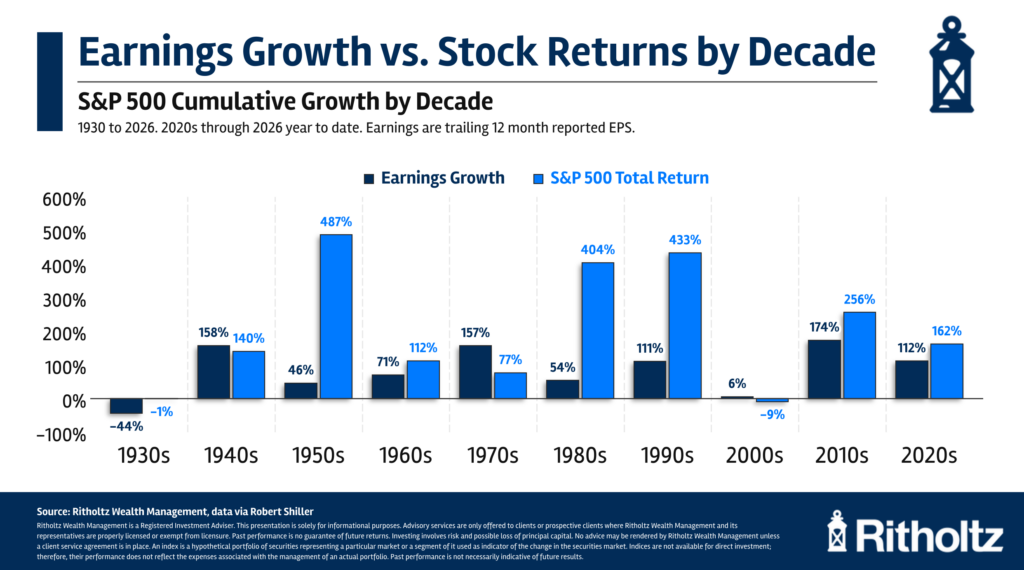
A recent post on the Wealth of Common Sense blog asks a question many investors have been asking: why are corporate earnings up so much more than the stock market this year? The gap is less puzzling than it looks, and it says more about expectations than about the underlying health of businesses.
The simplest explanation is valuation. A stock's price is roughly its earnings multiplied by what investors are willing to pay for each dollar of those earnings, usually measured as the price-to-earnings ratio. If profits rise faster than prices, that ratio falls. Take a hypothetical index where earnings climb 15 percent while prices rise 5 percent. Investors are now paying less for every dollar of profit than they were at the start of the year. Nothing has to go wrong for this to happen. It only requires prices to lag behind a healthy rise in profits.
Why would prices lag? Expectations are the usual culprit. Markets move on how results compare with what was already priced in, not on whether results are good in absolute terms. A company can beat forecasts and still see its shares slip if investors had hoped for even more. Interest rates matter too, since higher rates make distant future profits less valuable today. And after a long stretch of strong returns, enthusiasm can simply cool without any clear bad news.
There is also a measurement issue. Headline index returns are often dominated by a small group of large companies, so the broad market can look weaker than the typical company's profit growth suggests. Reported earnings can be shaped by one-time items, accounting choices and share buybacks, which lift per-share figures even when total profits do not change much. Comparing one aggregate earnings number with one index level can therefore flatter or understate the picture.
For investors, a widening gap between earnings and prices is not an automatic signal to buy or sell. Falling multiples can leave room for prices to catch up if profit growth holds, which is the bullish reading. But they can also reflect doubts about how long current profit growth will last, which is the cautious one. The useful questions are whether earnings growth is broad or concentrated, whether the expectations built into prices are realistic, and whether valuations stabilize as profits keep rising.
Reporting based on an external source.