 Stakely
Average Net Worth by Age: What the Fed's 2025 Survey Shows
Personal Finance·October 21, 2026
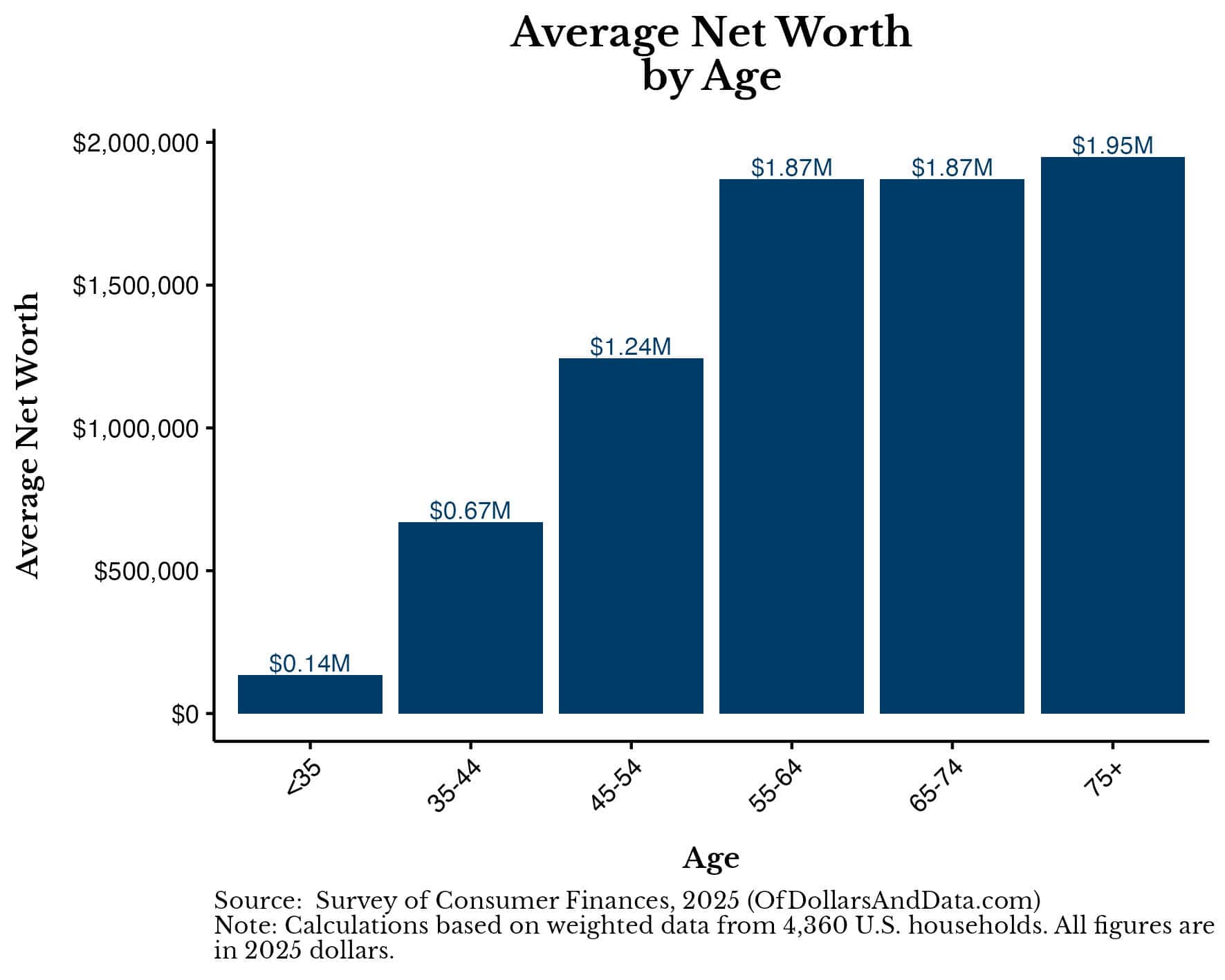
The average U.S. household held $1,231,997 in net worth in 2025, according to the Federal Reserve's 2025 Survey of Consumer Finances, measured in 2025 dollars. That is up about $72,550, or 6%, from $1,159,447 in 2022. The headline number is high for a reason. A small group of very wealthy households pulls the mean upward, so it says little about what a typical family has.
The median, the point where half of households sit above and half below, tells a more grounded story. It came in at $216,100 in 2025, less than a fifth of the average and only about 2% above the 2022 median of $210,887 after inflation.
Age changes the picture considerably. Average net worth rises from $43,566 for households under 25 to $588,215 for those aged 35 to 39, roughly $1.5 million for those aged 50 to 54, and about $2.1 million for those aged 60 to 64. Medians climb more slowly, from $13,050 under 25 to $127,170 at 35 to 39, $290,000 at 50 to 54, and $528,960 at 60 to 64. Wealth generally grows steadily until the early 60s and then levels off instead of falling. The survey is a one-time snapshot of different households, though, so it cannot prove what happens to any individual household over time. Small sample sizes in each five-year band also mean that some bumps, such as the dip at 55 to 59, are probably noise.
Within each age group, the spread is wide. Among households aged 35 to 44, the 25th percentile holds $18,000, the median is $156,000, and the 90th percentile reaches about $1.23 million. For those 75 and older, the 90th percentile is above $4 million.
Home equity is another major factor. Excluding it, the overall median drops from $216,100 to $69,200. For typical households aged 35 and older, home equity accounts for roughly 55% to 70% of net worth, while households in the top 20% of their age group hold a much smaller share in their homes, around 15% to 25%. Home equity is still real wealth that can be borrowed against or passed on, but it is not easily spendable, which is worth keeping in mind when comparing yourself to these benchmarks.
These numbers are reference points, not report cards. Career path, inheritances, and plain luck all shape where a household lands, and the median by age is usually a more useful yardstick than the average.
Reporting based on an external source.